

Marketplace · 2026
LINQ Building an Operating System for Nigeria's Service Economy
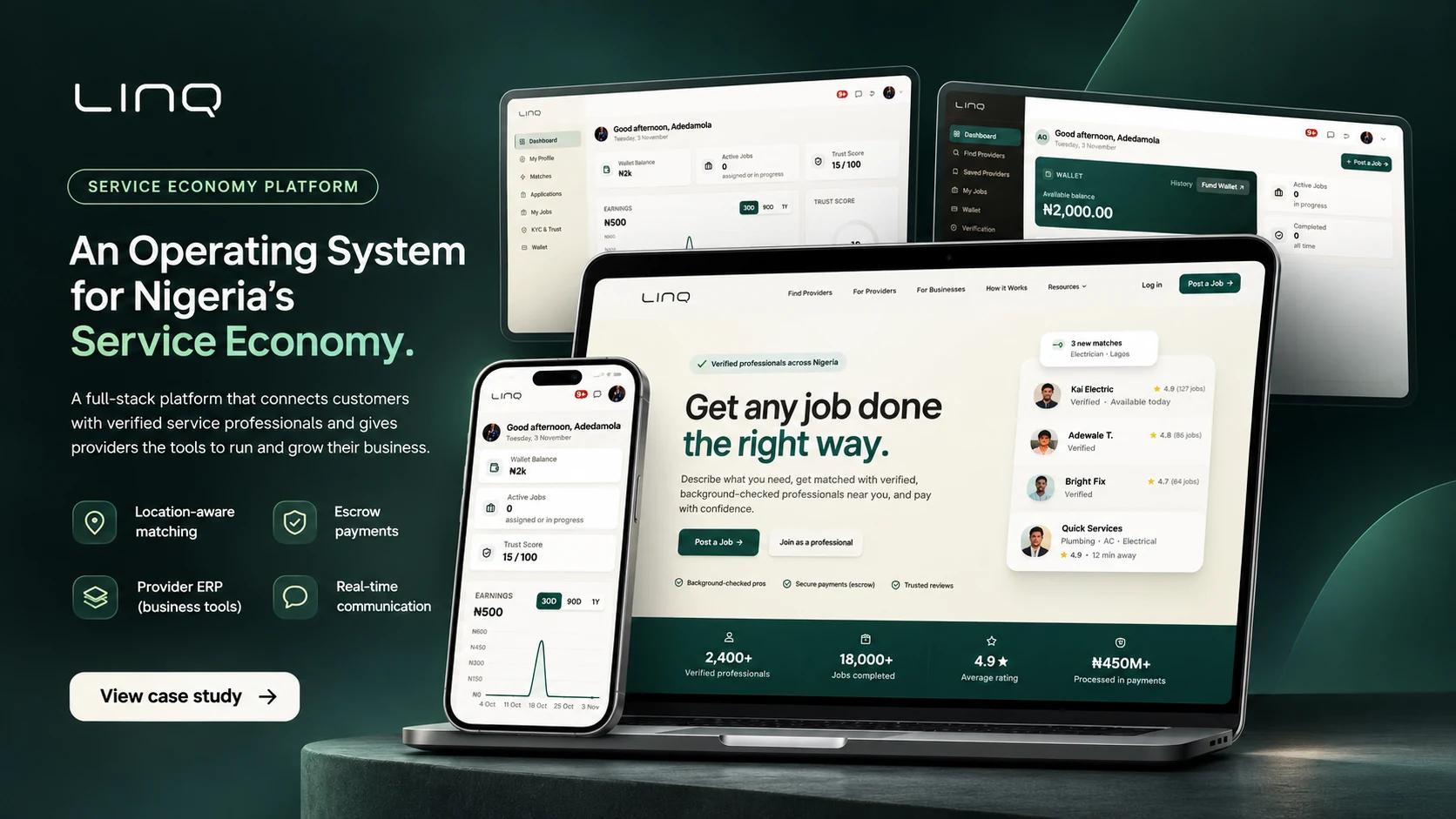
A service-economy platform combining verified provider discovery, location-aware matching, protected payments, and business tools for Nigerian service professionals.
- Year
- Market
- Type
- Role
- Scope
- Complete product design and full-stack development
Problem
Nigeria's service economy often operates through informal referrals, fragmented communications, and disconnected records. Customers may struggle to establish a provider's credibility, compare offers, coordinate work, and resolve payment disputes. Providers face a different set of obstacles: unpredictable demand, limited ways to build portable reputations, late payments, and scattered client, invoice, staff, and inventory records.
LINQ was conceived to address both sides of this problem. The challenge was not simply to list professionals online, but to build a cohesive system connecting trust, discovery, job execution, payments, and business operations—with workflows suited to Nigerian customers and service providers.
Approach
A service platform, not a listings directory. Architected the product around distinct customer, provider, and administrative experiences. A Laravel API supports core business operations while a Next.js application provides responsive, role-specific interfaces.
Structured job lifecycle. Built workflows for job posting, category selection, budgets, provider applications and bids, hiring, progress tracking, completion, and dispute handling. The system treats each job as a stateful transaction rather than an untracked lead.
Trust and identity. Implemented tiered onboarding, verification and reputation flows, with provider trust indicators used throughout the hiring experience.
Location-aware matching. Combined location, skills, availability, reputation and historical performance in provider discovery and ranking, with geospatial data supporting relevant nearby matches.
Payments and accountability. Integrated wallet and escrow-oriented transaction flows, settlement and payout workflows, and an administration-configurable payment gateway approach, with Paystack and Flutterwave as payment integrations.
Provider business tools. Extended the marketplace into an operating workspace with customer relationship management, job tracking, invoicing, earnings views, inventory, staff and appointment management, and subscription-based features.
Communication and operations. Delivered in-app messaging, voice-note support, notifications, support and dispute workflows, and an administrative console for operational oversight, configuration and monitoring.
Deployment and maintainability. Separated the Next.js frontend from the Laravel API, with PostgreSQL, Redis-backed workloads, managed media storage, observability, and cloud-based deployment services.
Stack
- Next.js
- React
- Tailwind CSS
- Shadcn
- Laravel
- PHP
- PostgreSQL
- PostGIS
- Redis
- Horizon
- Meilisearch
- Cloudinary
- Cloudflare R2
- Paystack
- Flutterwave
- Brevo
- Sentry
- Vercel
- cPanel
- Cloudflare
- Pusher
- Laravel Reverb
The platform uses Next.js 16 and React 19.2 for the frontend, a Laravel 13 API for the backend, PostgreSQL 18 with PostGIS for relational and geospatial data, and Redis with Horizon for cache and background processing. The interface uses Tailwind CSS and shadcn/ui, with TanStack Query and Zustand for client-side state. Meilisearch powers search; Cloudinary handles images and Cloudflare R2 handles documents, voice notes and other files. Payments use Paystack and Flutterwave with admin-configurable gateway selection; Brevo supports messaging; Sentry supports error monitoring; real-time features use Pusher and Laravel Reverb. The Next.js app runs on Vercel, the Laravel API on cPanel, with Cloudflare at the edge.
Result
Launched in August 2026, LINQ is a live, unified service-economy platform bringing customer discovery and hiring together with verified provider profiles, job management, communications, financial workflows, and provider business-management tools.
The delivered product spans customer, provider, and administrative experiences rather than a standalone marketplace directory. Its engineering significance lies in integrating several interdependent workflows—identity, matching, job state, transactions, communications, and business operations—into one coherent product.
Gallery
Screens from the build.
A closer look at the finished screens. Select any image to enlarge.